
How our Fintech client cut escalated bugs by 96% while growing 4x
QA Ownership
One of Europe's fastest-growing business finance platforms were growing their customer base rapidly. They had a growing need of stability and managing bug firefighting. Here's how structure quality assurance managed to provide long-term NPS increase.
The business problem: Quality at scale
We’d been working together with this fintech client for years now. They were in a phase of growing rapidly - and bug sensitivity was increasing. Bugs were reaching customers at a rate that was damaging satisfaction scores. Releases were slower - regression testing alone was consuming 13 days per cycle, which meant the team could only ship monthly.
The compounding issue was the support team losing valuable time on the wrong bugs. Engineering, product, and support all had different instincts about what was "urgent." Triage meetings became negotiations. Developers were being pulled into reactive firefighting on issues that, in hindsight, didn't warrant it. Roadmap delivery was suffering.
For a CEO or CTO watching this play out, losing NPS over quality is critial, while also losing team motivation amongst developers.
What we built together: Structured QA ownership
Over 28 months, PLAN A embedded a dedicated QA team into the client's engineering organization. Senior QA engineers took ownership, redesigning the process and helping the support team reduce the important bugs. This meant both manual and automated testing strategies, quality gates before each release, and the cultural shift of managing a shared understanding of quality.
One structural change was implementing a bug priority matrix - a classification framework that mapped every defect across two dimensions: technical severity and business impact. This eliminated the subjective debates and gave every team member, regardless of seniority or function, the same language and the same decision rules.
The matrix includes four quadrants:
- P1 - Critical bug (high severity, high business impact - like a checkout flow not working) gets an immediate hotfix within 24 hours.
- P2 - Major (low severity, high business impact - like a UI mismatch on a key flow) gets resolved within one sprint.
- P3 - Minor (low severity, low business impact - typos, layout tweaks) goes into the next planned release.
- P4 - Trivial (high severity, low business impact - like a crash in an unused background job) gets fixed when feasible. Four levels, clear definitions, no debate.
With that framework in place, triage meetings became fast and consistent. Developers stopped getting pulled into "urgent" requests that weren't - which meant they could stay focused on moving the business forward, working on the key functionalities.
Alongside the framework, together with the client we progressively built out 80% automated test coverage - the infrastructure that ultimately made same-day regression testing possible and gave the team the confidence to ship even biweekly.
The results: Long-term bug decrease
After just three months, there was a significant decrease of urgent and escalated bugs. Long-term - we measured the following results:
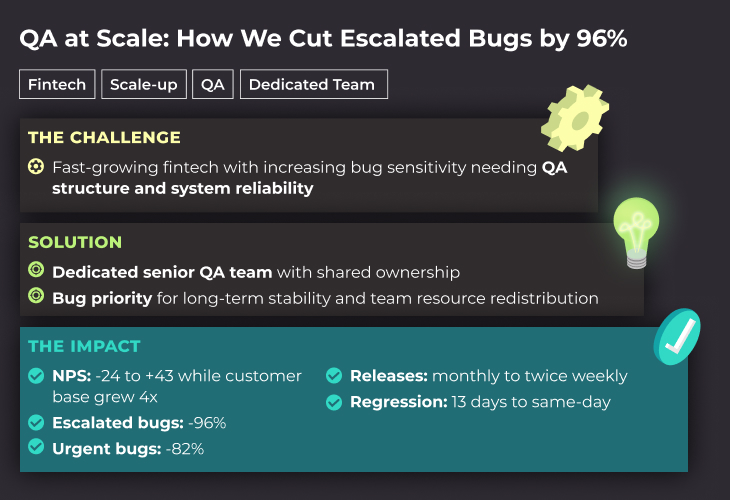
- Escalated bugs: 96% decrease - from 7.75 per month to 0.25 per month
- Urgent bugs: 82% decrease - from 17.16 per month to 5.91 per month
- Sustained 75%+ year-over-year urgent bug reduction, consistently across all periods
- NPS improved from -24 to +43 while the customer base grew 4x
- Release frequency went from monthly to twice weekly
- Regression testing cycle went from 13 days to same-day
The release frequency speaks for itself. From once a month to twice a week can bring significant competitive advantage for the client. This alone can create faster feedback loops, iteration and response to market signals.
Why this matters for any scaling product company
This case illustrates something we see across fintech and SaaS businesses at growth stage: quality problems are almost never just a testing problem, but more of an organizational clarity problem.
When there's no shared definition of what a bug means to the business, every release becomes a negotiation between engineering instinct, product pressure, and customer support noise. The teams with the loudest voices win, damaging the long term business plan.
What changed for our client was adding more senior ownership and capacity, working together to a clear decision framework, and building the engineering infrastructure to automate the repeatable work. Those three things together made the results compound over time, not plateau, leaving the 96% reduction in bugs a long-term result for the company.
If you'd like to follow us and recieve more insights about quality assurance, subscribe to our newsletter below.
Learn more about the bug priority matrix with our free resource: Download the Bug Priority Matrix PDF.


