
6 Lessons from Building Production-Ready Systems
AI is a Long Game
AI is not just a trendy word anymore - it's becoming integral to operations and crucial for data automation. But many AI projects get built without the long game in mind. The pilot impresses, gets handed over, and the tool gets bypassed due to a lack of real usability.
Over the past two years, our team has delivered AI systems across multiple enterprise projects spanning industrial equipment, financial services, and project management. The technical approaches varied significantly: fine-tuned LLMs, multimodal RAG, computer vision pipelines, AI agents.
At PLAN A, we approach every AI engagement through Forward Deployed Engineering - embedding our engineers directly into client environments rather than building from the outside in. This means we work with your data, your workflows, and your teams from day one. The result is systems that get adopted, deliver ROI, and become core infrastructure, rather than experiments.
What We're Seeing Across the Industry
A few things keep appearing repeatedly in enterprise AI adoption.
The highest ROI consistently comes from unstructured data - messy emails, dense PDFs, free-text descriptions, scanned documents. Traditional software has largely ignored this layer. AI hasn't, and that's where the real operational leverage is.
Generic models underperform in domain-specific contexts almost universally. Fine-tuning or grounding a model with organizational knowledge is not an enhancement - it's a prerequisite for useful output.
Human-in-the-loop is not a compromise. In every project we've delivered, approval workflows and confidence scoring were what built user trust - not accuracy benchmarks.
Four Projects, Four Contexts
To ground the lessons that follow, here's what each of our recent AI projects involved.
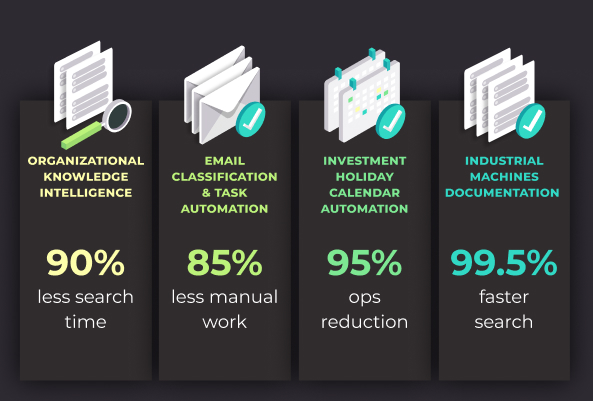
Organizational Knowledge Intelligence System - Project Management Consulting
A project management organization with 40,000+ internal documents was losing institutional knowledge to search inefficiency - employees spent 15+ hours weekly looking for information that existed but couldn't be found. We built a custom fine-tuned LLM on 20,000+ auto-generated instruction pairs. Document analysis time dropped by 90%.
Email Classification & Task Automation System - Project Management Consulting
The same organization processed thousands of emails daily, manually and inconsistently. We deployed a local LLM classification system with a real-time approval dashboard that learned from operator corrections. Manual processing was reduced by 85%, with classification accuracy reaching 94%.
Investment Holiday Calendar Automation - Financial Services
A financial services firm was handling global trading exchange holiday calendar requests almost entirely by hand - a compliance-critical, error-prone workflow. We built an AI agent pipeline to extract exchange names, map MIC codes, and generate formatted outputs automatically. Manual operations were reduced by 95%, and MIC code accuracy reached 97%.
Industrial Machines Documentation - Industrial Equipment
An industrial equipment company had 76,000+ PDF documents - manuals, catalogs, specifications - that were effectively unsearchable. We built a multimodal RAG system using Claude 3.5 Sonnet on AWS Bedrock to extract data from tables and images alongside text. Search time went from 30 minutes to 5 seconds.
Takeaways from Practical AI Implementation
1. Start with the workflow, not the technology
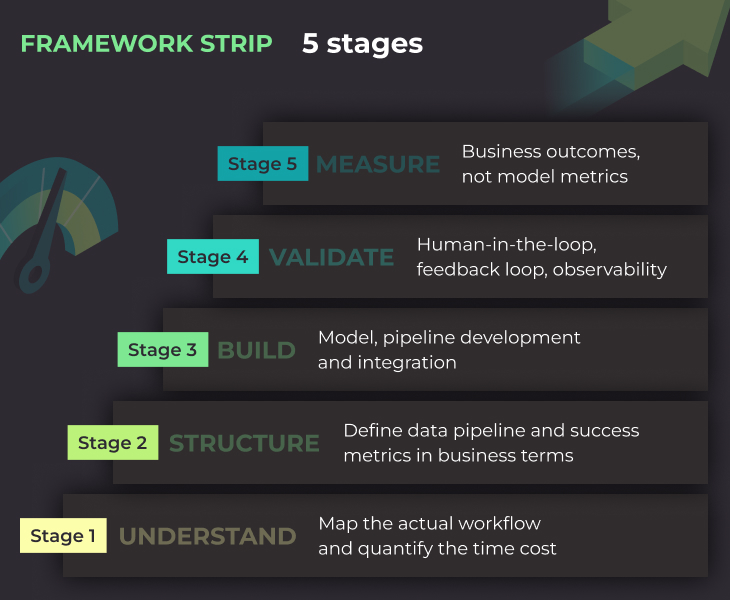
The most useful work in each project happened before any code was written. Understanding how people worked - where time was spent, where decisions were made manually, where mistakes clustered - defined the solution more than any architectural decision. The technology choice followed from the problem. It was never the starting point.
2. Identify where the data is messy and start there
Every project involved a layer of unstructured, inconsistent, or difficult-to-access data that existing systems couldn't handle. That layer was also where the operational pain was highest. Targeting it directly - rather than building around it - produced the most significant results.
3. Build feedback loops before you consider the system finished
The systems that improved over time had correction mechanisms designed in from the beginning. The email classifier didn't reach 94% accuracy at launch - it got there because misclassifications were captured, reviewed, and fed back in. A system without a feedback loop is a system at peak performance on day one. That's not infrastructure - that's a static tool.
4. Invest in the data pipeline seriously and early
Roughly 70% of the work in each project was data preparation: cleaning, structuring, generating training examples, building ingestion pipelines. Teams that treat this as a secondary concern consistently run over time and over budget. The model is the smallest part of the effort.
5. Measure in business language from the start
Hours saved per week. Reduction in error rate. Time from request to response. These are the metrics that determine whether a project is considered successful by the people using it and funding it. Establishing a clear before-metric at the start of a project is what makes the after-metric meaningful. Without it, impact is anecdotal.
6. Design for trust, not just accuracy
In every deployment, the speed of adoption correlated more with how transparent the system was than how accurate it was. Source document links, confidence scores, and the ability to override or correct outputs built trust faster than performance benchmarks. Users need to understand what the system is doing and feel that they remain in control. AI that augments a workflow gets adopted. AI that replaces it without explanation gets worked around.
The Real Bottleneck: Adoption
Technical delivery is the part most engineering teams are comfortable with. Adoption is harder and less discussed - and in our experience, it's where AI projects most often fail quietly.
Three things consistently determined whether a system became core infrastructure or a shelved experiment. First, whether users received genuine training and onboarding - not a demo, but real time with the tool. Second, whether there was an internal champion who understood and advocated for it. Third, whether the system was positioned as a productivity multiplier rather than a replacement.
The organizations that treated AI as a long-term operational capability - something to be developed, refined, and expanded over time - got compounding returns. The ones that treated it as a one-time project got one-time results.
The technology available today is genuinely capable. The limiting factor in enterprise AI is almost never the model. It is the clarity of the problem definition, the quality of the data infrastructure, and the deliberateness of the adoption process. Those are engineering and organizational challenges. They are also, fortunately, solvable ones.


