
How AI Can Automate 95% of a Financial Operations Workflow
AI in Financial Services Use Case
A financial services organization was spending 40+ hours every week manually processing requests for trading exchange holiday calendars. Every request required employees to interpret emails, identify exchanges, map them to official MIC codes, generate the relevant data, and prepare a response.
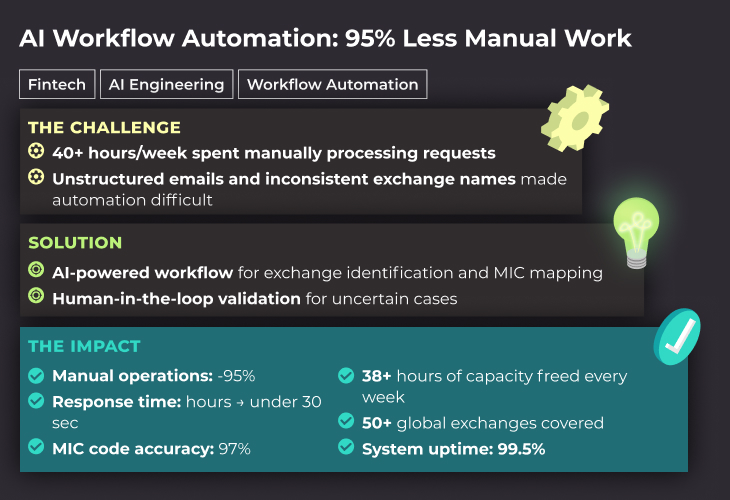
This project used an AI-powered automation system that reduced manual operations by 95%, achieved 97% MIC code accuracy, and cut response times from hours to under 30 seconds.
The result was a repetitive operational process became a scalable, automated workflow - freeing specialist capacity while maintaining the accuracy and oversight required in financial services. This resulted for increased velocity and reduced cost for the business.
The business problem: Operational capacity tied up in repetitive work
The organization received requests for holiday calendars covering more than 50 global trading exchanges. Although the task was repetitive, it required enough domain knowledge and precision that it couldn't be delegated to a basic automation rule.
Every request involved several manual steps:
- Interpreting customer requests and identifying the relevant exchanges
- Mapping inconsistent exchange names to official MIC codes
- Generating accurate holiday data for the requested markets
- Preparing and delivering CSV files
- Checking the output to avoid errors that could affect trading operations
The business impact was significant.
More than 40 hours of employee time every week were tied up in a process that was largely repetitive - response times stretched into hours, capacity was difficult to scale during volume spikes, and manual mapping introduced avoidable operational risk.
For decision-makers, the challenge was that specialist capacity was being consumed by a process that could be standardized and automated, it just needed a more complex technical solution which was now possible with the help of AI and an experienced enigneer.
The opportunity was to reduce that operational burden without compromising accuracy, control, or auditability.
Unique requirements
| Requirement | Business implication |
|---|---|
| 50+ global exchanges | Support international operations at scale |
| 97%+ MIC code accuracy | Minimize operational risk |
| Sub-minute response | Improve customer responsiveness |
| Audit trail | Maintain control and traceability |
| Scalability | Handle demand spikes without proportional staffing |
The solution: AI-powered workflow automation
The project team built an end-to-end AI workflow that turns an incoming customer email into a validated holiday calendar with minimal human intervention.
AI handles the interpretation. LLM agents using OpenAI and Claude identify exchange references in incoming emails and map them to standardized MIC codes, even when customers use informal or abbreviated names.
Confidence scoring keeps humans in control. High-confidence mappings can move through the workflow automatically, while uncertain cases are routed to a human approval dashboard. This preserves oversight where it matters without requiring employees to review every request.
The workflow runs end to end. Once the exchange is confirmed, holiday data is generated for the relevant markets, the CSV is created, and the response is delivered automatically.
The system gets better over time. Approved mappings feed back into the system, improving future suggestions and reducing the amount of manual intervention required.
Tech Stack
| Component | Technology |
|---|---|
| AI Agents | OpenAI / Claude APIs |
| Backend | Python FastAPI |
| Frontend | React (approval dashboard) |
| Database | MySQL |
| Workflow | n8n orchestration |
| Calendar Data | pandas-market-calendars |
| Caching | Redis |
| Monitoring | Prometheus, Grafana, ELK stack |
| Infrastructure | Docker microservices |
The results: Capacity unlocked and faster customer response
After implementation, the business saw a fundamental change in how the process operated:
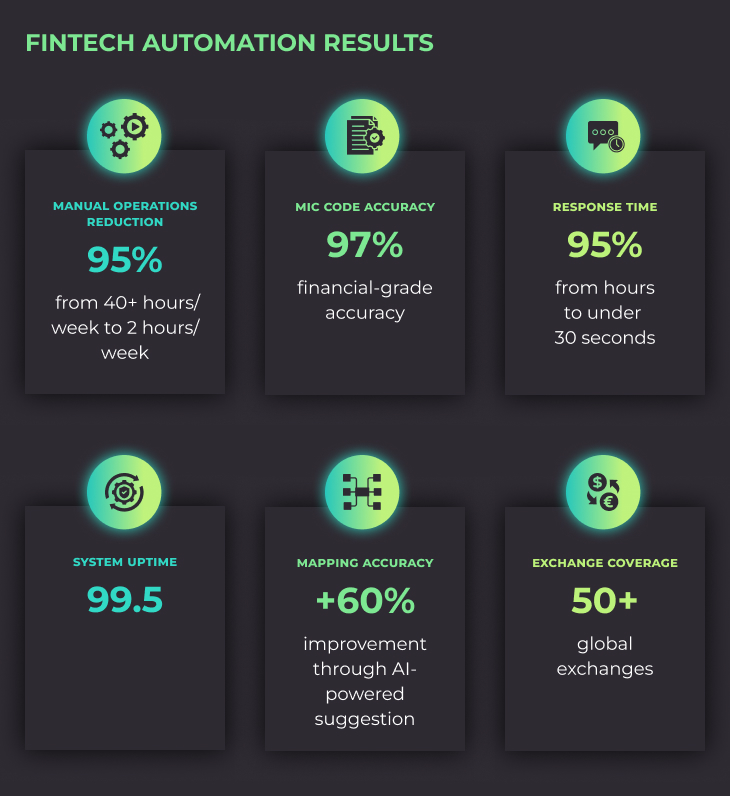
- Manual operations: from 40+ hours/week to 2 hours/week - 95% reduction
- MIC code accuracy: 97% - financial-grade accuracy
- Response time: from hours to under 30 seconds
- System uptime: 99.5%
- Mapping accuracy: +60% improvement through AI-powered suggestions
- Exchange coverage: 50+ global exchanges
How the results impacted business owners
38+ hours of operational capacity are freed up every week. Employees who previously spent their time reading requests, checking exchange names, generating files, and sending responses can focus on work that requires human judgment and domain expertise.
At the same time, customers get answers in seconds rather than hours, without requiring the organization to increase headcount as request volumes grow.
The system also creates a more predictable operation: instead of capacity being directly tied to the number of incoming requests, the workflow can absorb volume spikes without a proportional increase in manual effort.
Looking beyond the technology is key
The key lesson is that AI value comes from redesigning the workflow around what AI can reliably automate.
In this case, three capabilities made the difference:
- AI agents handle unstructured input - customer requests don't need to follow a rigid format for the system to understand them.
- Human oversight is applied selectively - employees remain responsible for uncertain or sensitive decisions rather than checking every transaction manually.
- Automation connects the entire process - n8n orchestrates extraction, validation, data generation, CSV creation, and delivery as one workflow.
The business goal obtained was to ensure highly skilled people aren't spending 40+ hours a week doing work that software can handle - while improving speed, consistency, and scalability at the same time.
AI engineering really makes a difference: understanding which parts of a workflow can be automated reliably, where human judgment still matters, and how to connect AI capabilities to the systems and processes a business already depends on.


