
Cybersecurity as a Growth Enabler
Add security into your technology strategy
A few years ago, cybersecurity was something only large enterprises worried about. Today it's a conversation happening in board meetings, investor calls, and procurement reviews at companies of every size.
If you're a SaaS product, a fintech, an e-commerce platform, or any business handling sensitive customer data - you inevitably become more attractive targets. And for enterprises - systematic attacks happen weekly.
Companies in need of cybersecurity
All companies can benefit from cybersecurity, but most commonly, the clients share few of the following traits:
- They're scaling;
- They’re established enterprises, that, although having internal security functions, receive a large volume of attacks;
- They handle sensitive data - financial, personal, or both;
- They're entering enterprise sales cycles where security evidence is a must;
- They're under regulatory pressure from frameworks like NIS2, DORA, PCI-DSS, ISO 27001, or SOC 2.
Most mid-size companies have never run a formal security test. They've relied on their development team to "keep things secure", which is only a temporary solution. For enterprises with existing security functions, the challenge is developing blind spots, which an external audit surfaces.
Structured security testing ensures clarity
The immediate output of a penetration test is a report.
But what it gives you is clarity - a ranked, evidence-based picture of where you're exposed and where to start.
Beyond the technical findings, companies consistently report three business outcomes:
- Faster enterprise sales cycles;
- Reduced insurance premiums;
- Internal confidence that the product can be defended publicly.
For enterprises, add a fourth: independent validation that satisfies board-level and regulatory requirements.
A Security Maturity Assessment goes one step further - it maps your entire security posture against established frameworks and produces a prioritized roadmap. For companies that don't know where to start, it's the right first step before any testing begins.
Ensure cybersecurity with an end-to-end technological partner
Cybersecurity is most effective when it's part of a broader technology strategy. A technological partner can lead the strategy, coordination, delivery, and remediation process, working with certified cybersecurity specialists with deep expertise across testing, compliance, and security operations.
Cybersecurity has never been a separate discipline within our work - it has been part of how we design, build, and operate technology solutions for our clients. As demand for dedicated security expertise continues to grow, we are now formalizing this capability as a standalone offering, complementing our work across managed teams, digitalization, AI services, quality assurance, and technology consulting.
Our clients benefit from senior guidance, proven expertise, and a single point of contact throughout the entire engagement - from initial assessment to implementation and follow-up actions.
Our Cybersecurity Services
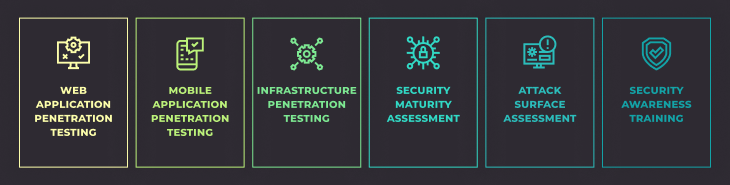
Web Application Penetration Testing
A controlled, authorized test of your web application or API against the OWASP Top 10 and beyond - SQL injection, broken authentication, access control failures, business logic errors. Available as grey-box (recommended for most companies) or black-box. Deliverables include a board-ready executive summary and a CVSS-rated technical report your engineering team can act on directly. Scope ranges from a single app to an enterprise platform.
Mobile Application Penetration Testing
Security testing for iOS and Android applications covering local data storage, network communications, authentication, and reverse-engineering resistance - typically combined with backend API testing. Relevant for any company shipping a customer-facing mobile product, particularly in fintech, banking, and health.
Infrastructure Penetration Testing
Testing of servers, networks, firewalls, Active Directory, VPN gateways, and cloud infrastructure across AWS, GCP, and Azure. External testing covers your internet-facing systems; internal testing models what an attacker - or a compromised insider - could reach once inside. Relevant for any company under NIS2 or DORA, and for businesses that need evidence for cyber insurance.
Security Maturity Assessment
A high-level evaluation of your overall security posture, benchmarked against NIST CSF and CIS Controls. Produces a maturity score and a prioritized improvement roadmap. No technical access required - making it the natural starting point for companies that want to understand where they stand before committing to a full testing program.
Attack Surface Assessment
Discovery and analysis of everything an attacker can see from the outside - exposed services, cloud misconfigurations, shadow IT, and information leaked through code repositories or job listings. Non-intrusive and fast to deliver. Almost always surfaces findings that justify a follow-on engagement.
Security Awareness Training
Half-day or full-day training for your team covering phishing recognition, password hygiene, social engineering, and incident reporting. Around 80% of successful attacks involve human error. ISO 27001, SOC 2, NIS2, and DORA all require regular awareness training - this covers that requirement practically and without disruption.
Bottom line
Cybersecurity doesn't have to mean a six-month compliance project. For most companies - whether you're running your first security test or auditing an existing program - the right starting point is a single well-scoped engagement that gives you a clear picture of your exposure and a defensible answer for the next time someone asks.
If you want to understand where your product stands, we're happy to have that conversation – start a chat with us!


